English
Sign in
| Price | negotiated |
| MOQ | 1000m |
| Delivery Time | 15working days |
| Brand | Florescence |
| Place of Origin | China |
| Certification | CCS |
| Model Number | UHMWPE Rope |
| Packaging Details | woven bags |
| Payment Terms | T/T,Western Union |
| Supply Ability | 100000m |
| Payment Term | by T/T | Place of Origin | China |
| Size | 6mm-96mm | Abrasion Resistance | High |
| Packaging Details | woven bags | Color | Blue, Black, Red, Orange |
| Fiber | uhmwpe fiber | Model Number | UHMWPE Rope |
| Supply Ability | 100000m | Feature | Anti-uv |
| Certification | CCS | Name | UHMWPE Rope |
| Brand Name | Florescence | Payment Terms | T/T,Western Union |
| Packing | Woven bags | Price | negotiated |
| Delivery Time | 15working days | Minimum Order Quantity | 1000m |
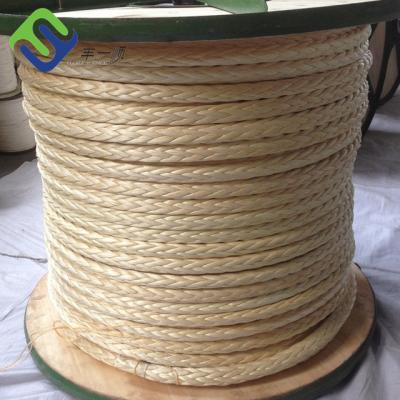
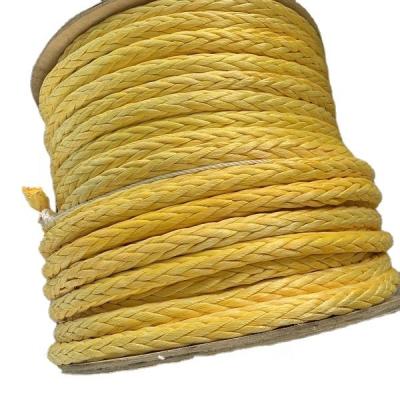
| Length/Coil | 220m/200m | Structure | 12 Strands Braided |
| Low Elongation | Yes | Application | Marine Towing |

Knotting & Splicing: Very slippery! Standard knots (like bowlines) can slip and fail. Use knots with multiple tucks (e.g., Double Dragon, Zeppelin Bend) or splices. The 12-strand construction is designed for easy and secure eye splicing, which is the preferred termination method.
Heat Sensitivity: The fibers melt at a lower temperature than nylon/polyester (around 144°C / 292°F). Friction from rapid slippage over a winch or bitt can melt and weaken the rope instantly. Avoid high-friction scenarios.
Creep: Under constant, high load, UHMWPE can slowly elongate over time (creep). This is a consideration for permanent, structural rigging.
Shock Loads: Unlike nylon, it doesn't absorb energy through stretch. This means shock loads transmit high forces directly to the anchor points. It's strong but not elastic.
Cutting on Edges: While abrasion-resistant, it is vulnerable to being cut if tensioned over a sharp edge. Use edge protection.
Cost: Significantly more expensive than nylon, polyester, or polypropylene ropes.
Marine & Sailboat Rigging: Running rigging (halyards, sheets), dock lines, tow lines, and anchor rodes (often as a core inside a polyester sleeve for chafe protection).
Towing & Recovery: Used by off-roaders, marine salvage, and industry due to its strength, safety (energy absorption is different from steel), and light weight.
Arborist & Rigging: For high-strength, low-stretch applications like pull lines and rigging, though its slipperiness requires specific knots and hitches.
Industrial & Fall Protection: In lifting, lashing, and as the core component in high-tech safety lanyards.
Climbing & Rescue (Specialized): For lightweight haul systems, rescue lines, and anchor slings, though it requires specialized knowledge due to its unique behavior under shock loads.


UHMWPE fiber is manufactured into rope using several braiding techniques, each suited to different applications:
12-Strand Single Braid (12-Carrier): A hollow, braided construction that is very flexible and has a smooth surface. It is easy to splice and is popular for general purpose, winch lines, and tow ropes.
Double Braid (Braid-on-Braid): Features a braided core (the "soul") inside a braided cover (the "jacket"). This construction offers excellent strength, durability, and handling, and is very resistant to kinking. Common for dock lines, winch lines, and heavy-duty lifting.
Parallel Core (With a Cover): A bundle of parallel, non-twisted UHMWPE fibers (the core) provides the strength, protected by a durable woven jacket (often from polyester or another material). The jacket protects the core from UV and abrasion. This is typical for synthetic winch lines for off-road vehicles.
3-Strand: A traditional twisted construction. Less common for UHMWPE as the braided designs better exploit its flexibility and strength.