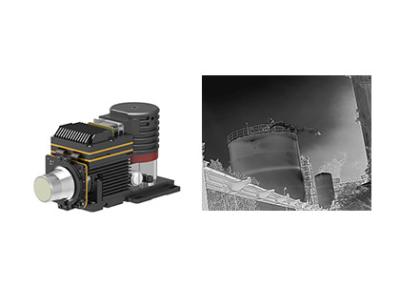
Gas Leakage Detecting MWIR Cooled Optical Gas Imaging Infrared Detector 320x256/30μm
320x256/30 μm MWIR Cooled Optical Gas Imaging Thermal Detector for Visualizing CO Gas Leaks
Product Overview
Carbon monoxide (CO) is prevalent in high-temperature metallurgy, petroleum refining, and industrial processes. This colorless, odorless, highly toxic gas easily diffuses, making detection challenging. Traditional methods suffer from significant blind spots and high missed detection rates.
The LFD330Z7 infrared gas leak detection detector enables rapid wide-area scanning, precise leak source localization from a distance, and clear imaging capabilities. This technology empowers inspection personnel to efficiently identify potential hazards and ensure operational safety.
Main Features
- High sensitivity and reliability
- High effective pixel rate
- Clear visualization of minor leaks
- Gas enhanced HSM algorithm support (for module)
- Easy integration with various interfaces
- RAW/YUV image output support
Product Specifications
| Detector model | LFD330Z7 |
| Resolution | 320×256 |
| Pixel size | 30μm |
| Spectral response | 4.5±0.1μm~4.7±0.1μm |
| Typical NETD | 10mK (F1.5) |
| Cooling time (23℃) | ≤7min@12V |
| Power consumption (23℃) | ≤15W@12V (Peak)
≤7W@12V (Stable) |
| Size (mm) | 142×58.5×71 |
| Weight (g) | ≤600g |
| Working temperature | -45℃~+71℃ |
| Storage temperature | -55℃~+71℃ |
| MTTF | ≥10000h |
Industrial Applications
The LFM330Z7 cooled MWIR infrared camera core is extensively utilized across industries where CO leakage poses significant risks, transforming safety monitoring practices:
- Petrochemical industry: Detection during hydrocarbon combustion, catalytic reforming, and gas storage operations
- Metallurgical industry: Monitoring during steelmaking and non-ferrous metal smelting processes where incomplete fuel combustion generates CO
- Residential and commercial buildings: Identifying leaks from gas water heaters, furnaces, and boilers
- Scientific research and environmental monitoring: Studying CO emission mechanisms and tracking atmospheric CO distribution
Our Core Strengths
Stable Supply
We maintain a reliable supply chain throughout our ecosystem, enabling rapid response to market demands.
Sustaining Innovation
With expertise in detector manufacturing and system integration support, we gain deep insights into performance requirements, continuously optimize designs, and create a virtuous cycle: Product Application → Technical Feedback → Product Upgrade.
Cost Advantage
Through complete production chain management and efficient large-scale manufacturing, we deliver competitive pricing for diverse applications.
Frequently Asked Questions
What is thermal sensitivity?
Thermal Sensitivity, also known as NETD (Noise Equivalent Temperature Difference), is a critical parameter for evaluating medium wave (MWIR) and long wave (LWIR) thermal imaging cameras. It directly relates to the clarity measured by thermal imagers, representing the signal-to-noise ratio of temperature difference in milliKelvins (mK). Lower thermal sensitivity values indicate higher sensitivity and clearer imaging.
What are the applications of thermal imaging?
Temperature measurement and all-weather imaging represent the fundamental functions of infrared thermal imaging technology. Products developed using these technologies are widely deployed across security & monitoring, UAV payloads, industrial inspection, firefighting, predictive maintenance, ADAS, epidemic prevention, and AIoT applications.