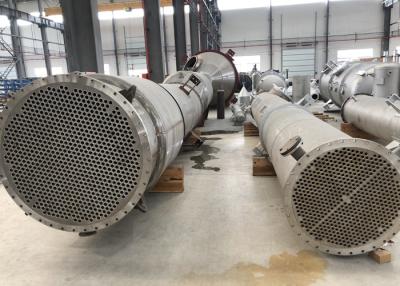
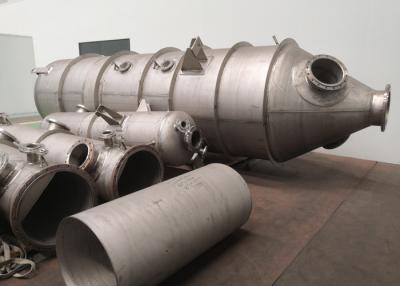
Laser
Welding
Enbossed
Pillow
Plate
MVR
Evaporators

Laser-welded
embossed
pillow
plates
combined
with
MVR
(Mechanical
Vapor
Recompression)
create
a
compact,
energy-saving
evaporator
body
with
wide
channels,
strong
turbulence,
and
hygienic
surfaces.
The
design
supports
gentle
vacuum
evaporation,
low
ΔT
operation,
and
continuous
24/7
duty
for
food,
chemical,
and
environmental
applications.
Key
Benefits
-
Energy
saving:
MVR
recycles
latent
heat;
minimal
fresh
steam
after
start-up.
-
High
heat
transfer:
Embossed
pillows
promote
turbulence
and
coefficients
at
low
ΔT.
-
Fouling
tolerance:
Wide
channels
handle
particulates/viscosity
better
than
narrow-gap
plates.
-
Hygienic
&
serviceable:
SS304/SS316L
surfaces,
drainable
geometry,
CIP-ready,
easy
inspection.
-
Modular
scaling:
Add/remove
plate
banks;
upgrade
path
to
TVR/MVR
hybrids.
Process
&
Thermal
Economy
Secondary
vapor
is
mechanically
compressed
to
raise
saturation
temperature
and
reused
as
the
heating
medium.
Uniform
film
distribution
over
pillow
plates
under
vacuum
maintains
high
heat-transfer
coefficients
and
protects
heat-sensitive
products,
reducing
specific
energy
consumption.
Materials
&
Construction
Laser-welded
SS304/SS316L
pillow
plates
and
manifolds
(duplex/Ti/Hastelloy
optional).
Orbital-welded
headers,
sanitary
finishes,
slope-to-drain
piping,
and
validated
CIP
documentation
available
for
food-grade
compliance.
Process
Overview
--
Pillow
Plate
MVR
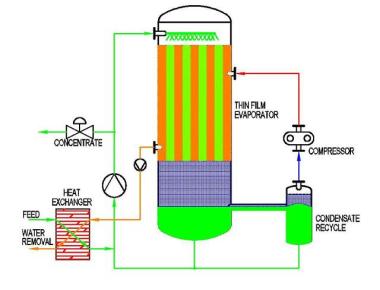
-
Feed
conditioning:
screening/filtration,
pH
trim,
antiscalant
to
limit
Ca/Mg/Si
scaling.
-
Falling-film
duty:
even
wetting
across
embossed
plates;
tight
ΔT/LMTD
control.
-
MVR
compression:
VFD-driven
compressor
sets
discharge
pressure
for
capacity/ΔT
control.
-
Condensate
polishing:
filters/RO/AC
for
reuse
or
compliant
discharge
(conductivity/TOC
guard).
-
Concentrate
routing:
to
crystallizer/centrifuge/dryer
or
recycle
per
ZLD/production
needs.
Key
Components
-
Laser-welded
embossed
pillow
plate
evaporator
stack
with
distributors/collectors
-
MVR
mechanical
vapor
compressor
(turbo/Roots)
with
VFD
-
Vapor-liquid
separator,
surface
condenser,
vacuum/NCG
handling
skid
-
Preheaters/heat-recovery
HX;
PLC/HMI/SCADA
with
historian
-
CIP
skid;
antiscalant
dosing;
T/P/flow/conductivity/level
instrumentation
Performance
&
Sizing
|
Parameter
|
Typical
Range*
|
|
Operation
|
Continuous,
vacuum
duty
|
|
Electric
use
(MVR)
|
~15-40
kWh
per
ton
of
water
evaporated
(duty/CR
dependent)
|
|
Film
ΔT
|
Low
for
quality
preservation;
set
via
compressor
discharge
pressure
|
|
Steam
demand
|
Very
low
after
start-up
(backup/ancillary
only)
|
|
Materials
|
SS304
/
SS316L
standard;
duplex/Ti/Hastelloy
optional
|
*Performance
depends
on
feed
chemistry/viscosity,
fouling
tendency,
compression
ratio,
and
plate
geometry.
FAQ
Why
choose
embossed
pillow
plates?
Embossing
increases
turbulence
and
stiffness,
improving
heat-transfer
coefficients
and
pressure
tolerance
at
low
ΔT.
Can
the
system
be
expanded
later?
Yes--add
plate
banks
or
integrate
TVR/MVR
hybrid
modules
to
increase
capacity
and
reduce
specific
energy
use.
Which
stainless
grade
should
we
pick?
SS316L
is
preferred
for
chlorides/corrosives;
SS304
suits
benign
duties.
Duplex/Ti/Hastelloy
available
per
corrosion
study.
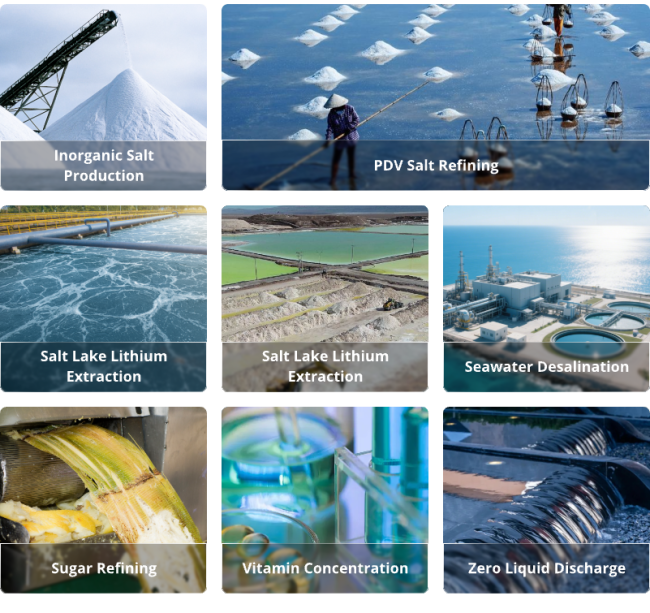
Application