English
Sign in
| Price | Negotiable |
| MOQ | 2000pcs |
| Delivery Time | 15-30 days |
| Brand | Henan Aile |
| Place of Origin | China |
| Certification | ISO/CE |
| Model Number | 4FR-8FR |
| Packaging Details | Individually packaged |
| Payment Terms | L/C, T/T |
| Supply Ability | 1000000 Pieces per Week |
| Place of Origin | China | Size | Double Lumen |
| Packaging Details | Individually packaged | Quality Certification | CE |
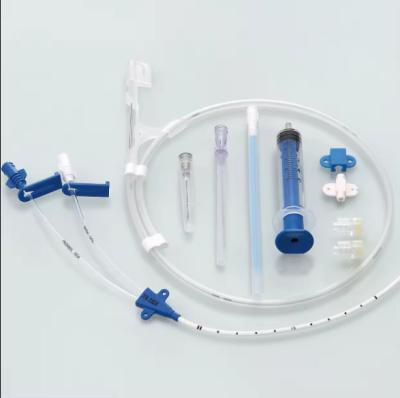
| Port | Shanghai /Guangzhou | Product Name | Medical CVC Kit Central Venous Catheter Set |
| Material | TPU | Model Number | 4FR-8FR |
| Properties | Medical infusion | Supply Ability | 1000000 Pieces per Week |
| Certification | ISO/CE | Brand Name | Henan Aile |
| Payment Terms | L/C, T/T | Instrument classification | Class III |
| Price | Negotiable | Delivery Time | 15-30 days |
| Minimum Order Quantity | 2000pcs | Tip | Medical CVC Kit Central Venous Catheter Set |
| Shelf Life | 3 years | Guide Wire | Stainless Steel/Nitinol |
| Stock | NO |
Central venous catheter double lumen medical CVC kit central venous catheter
A central venous catheter (CVC) is a type of catheter that is inserted into a large vein in the body to provide various medical interventions. It is also known as a central venous line or central line.
The purpose of a central venous catheter is to facilitate the administration of medications, fluids, blood products, or parenteral nutrition. It can also be used to monitor central venous pressure and obtain blood samples for laboratory testing. Compared to peripheral intravenous catheters, central venous catheters have the advantage of providing access to larger veins and can be used for a longer duration.
The insertion of a central venous catheter is typically performed by a healthcare professional in a sterile environment. The most common sites for insertion are the internal jugular vein (located in the neck), the subclavian vein (located beneath the collarbone), or the femoral vein (located in the groin area). The choice of insertion site depends on various factors such as the patient's medical condition, the purpose of catheter placement, and the healthcare provider's expertise.
Central venous catheters can be single-lumen (consisting of one tube) or multi-lumen (multiple tubes within a single catheter). Multi-lumen catheters allow for the simultaneous administration of multiple medications or fluids.

There are different types of central venous catheters, including non-tunneled catheters and tunneled catheters. Non-tunneled catheters are inserted directly into the vein and are generally used for short-term access. Tunneled catheters are inserted similarly, but the catheter is tunnelled under the skin before entering the vein. This type of catheter is used for long-term access and is often preferred when repeated or prolonged use is anticipated.
Complications associated with central venous catheters may include infection, thrombosis (blood clot formation), bleeding, pneumothorax (collapsed lung), and damage to surrounding structures. Proper care and maintenance of the catheter and the insertion site are essential to minimize the risk of complications.
It's important to note that while I strive to provide accurate and up-to-date information, it's always best to consult a healthcare professional or medical expert for specific medical advice or questions related to your individual circumstances.
Characteristics and attributes of a central venous catheter (CVC) include:
Insertion site: CVCs are typically inserted into larger veins in the body. Common insertion sites include the internal jugular vein, subclavian vein, or femoral vein.
Versatility: CVCs are used for the administration of medications, fluids, blood products, or parenteral nutrition. They can also be used for monitoring central venous pressure and obtaining blood samples for laboratory testing.
Single-lumen or multi-lumen: CVCs can be single-lumen (consisting of one tube) or multi-lumen (multiple tubes within a single catheter). Multi-lumen catheters allow for the simultaneous administration of multiple medications or fluids.
Short-term and long-term use: CVCs can be non-tunneled or tunneled. Non-tunneled catheters are inserted directly into the vein and are typically used for short-term access. Tunneled catheters are inserted in a similar manner but are tunneled under the skin before entering the vein. They are used for long-term access or when repeated or prolonged use is anticipated.
Risks and complications: Using a CVC carries the risk of complications such as infection, thrombosis (blood clot formation), bleeding, pneumothorax (collapsed lung), and damage to surrounding structures. Proper care and maintenance of the catheter and insertion site are crucial to minimize these risks.